
Best Soil Color and Quality for Vastu-Compliant Land
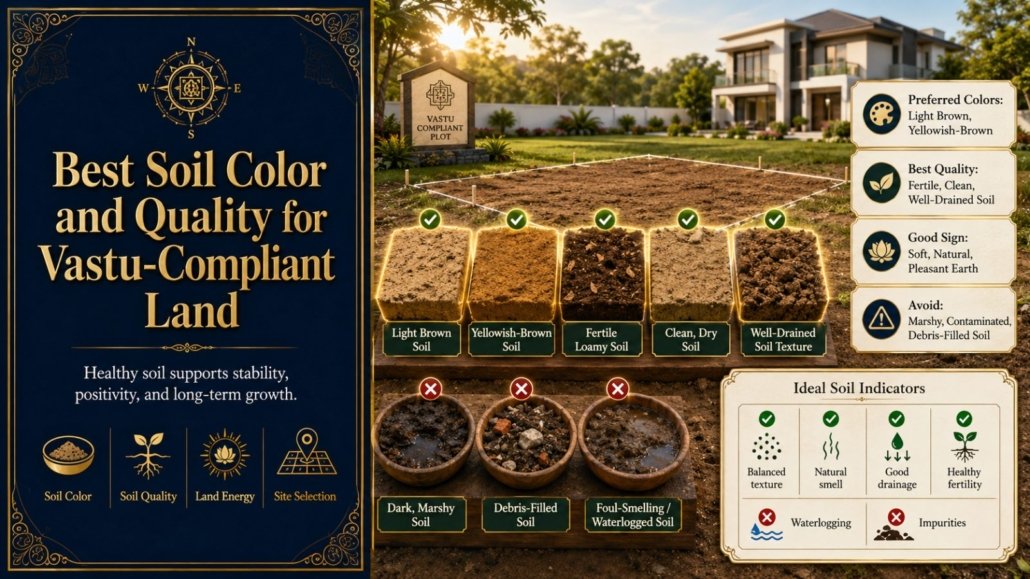
Best Soil Color and Quality for Vastu-Compliant Land
Before a building is designed, before the entrance is planned, before rooms are placed, and before construction begins, the land itself must be understood. In Vastu, soil is not only a construction base; it reflects the quality, strength, history and energy of the land.
Many people select a plot only by location, price, road width, size, view, resale value or builder recommendation. These factors are important, but they do not complete the land-selection process. A Vastu-compliant land evaluation should also consider soil color, soil smell, soil texture, fertility, moisture, contamination, firmness, water retention, previous land use, slope, shape, surroundings and energy condition.
Online content often gives simple statements such as “red soil is good” or “black soil is bad.” This is too general. Soil cannot be judged only by color. The same soil color may behave differently depending on the region, land history, drainage, compaction, minerals, moisture and construction requirement.
This article explains the best soil color and quality for Vastu-compliant land in a practical, professional and property-specific way.
Direct Answer
For Vastu-compliant land, soil should ideally be clean, firm, naturally pleasant in smell, stable, non-contaminated, not excessively sticky, not foul-smelling, not waterlogged and suitable for construction after technical soil testing. Soil colors such as light brown, yellowish, reddish or fertile earthy tones are generally considered more favourable than foul, overly black, marshy, polluted or chemically contaminated soil. However, final land suitability should be decided only after checking soil quality, plot direction, shape, slope, surroundings, land history and energy condition.
| Soil Factor | Vastu Importance | Professional View |
|---|---|---|
| Soil Color | Medium to High | Gives an initial indication, but cannot decide land quality alone. |
| Soil Smell | High | Foul smell, chemical smell or rotten smell needs serious caution. |
| Soil Texture | High | Soil should not be excessively loose, sticky, marshy or unstable. |
| Soil Firmness | Very High | Land must be suitable for construction after engineering soil testing. |
| Moisture | High | Waterlogging or excessive dampness can be problematic. |
| Contamination | Very High | Industrial waste, chemicals, garbage or sewage history needs deep evaluation. |
| Fertility | Medium | Healthy natural soil is generally preferable to dead or polluted soil. |
| Land Energy | Very High | May require on-site energy analysis in sensitive or high-value cases. |
Why Soil Quality Matters in Vastu
Soil is the first physical layer of the property. It supports the building, absorbs pressure, holds moisture, carries memory of previous use and influences the energetic quality of the land. A plot may have a good shape and good direction, but if the soil is weak, polluted, foul, unstable or energetically disturbed, the property may need deeper evaluation before construction.
In Vastu, land is not judged only by geometry. Bhoomi, or land, is studied for strength, purity, fertility, slope, shape, surroundings, history and energy. Soil condition is one of the most important signals in that evaluation.
A Vastu-compliant plot is not only about direction and entrance. It begins with the quality of the land under your feet.
| Land Quality Area | Why It Matters |
|---|---|
| Foundation support | Weak soil may create structural and settlement concerns. |
| Moisture behaviour | Excess water retention may create dampness and instability. |
| Previous land use | Old dumping grounds, burial areas, sewage land or industrial waste zones need caution. |
| Natural smell | Healthy soil usually does not have foul or chemical smell. |
| Energy condition | Some lands may feel heavy, disturbed or unsuitable despite good appearance. |
| Construction suitability | Engineering soil testing is essential before construction. |
Best Soil Colors for Vastu-Compliant Land
Soil color can give an initial impression of the land, but it should never be the only basis for selection. The same color may have different meanings in different regions. Still, traditional Vastu evaluation often gives importance to natural, clean, stable and fertile-looking soil.
| Soil Color | General Vastu View | Professional Interpretation |
|---|---|---|
| Light Brown Soil | Generally favourable | Often indicates natural, stable and balanced land when clean and firm. |
| Yellowish Soil | Often considered favourable | Can be suitable when the soil is dry, stable, clean and non-toxic. |
| Reddish Soil | Often considered good in many traditions | May indicate strength and vitality, but engineering suitability must be checked. |
| White or Pale Soil | Needs careful study | May be acceptable in some regions, but texture, minerals and strength must be checked. |
| Dark Brown Soil | Can be good when fertile and clean | Needs moisture and stability evaluation. |
| Black Soil | Needs caution | May hold moisture or expand/shrink in some regions; technical testing is important. |
| Grey Soil | Needs caution | May indicate poor drainage, ash, pollution or unusual land history in some cases. |
| Greenish / Bluish / Foul Soil | Generally unsuitable | May indicate decay, contamination, chemical effect or waterlogging. |
Light Brown Soil in Vastu
Light brown soil is generally considered balanced and acceptable when it is clean, stable, naturally earthy in smell and suitable for construction. It often indicates a normal natural land condition.
However, even light brown soil should not be accepted without checking firmness, slope, moisture, compaction and land history. A clean-looking plot may still have hidden dumping, filling or weak foundation conditions.
| Light Brown Soil Check | Professional View |
|---|---|
| Clean appearance | Positive initial sign. |
| Natural smell | Should not smell rotten, chemical or sewage-like. |
| Firmness | Must be stable enough for construction after testing. |
| Moisture | Should not be excessively damp or marshy. |
Yellowish Soil in Vastu
Yellowish soil is often considered favourable in Vastu when it is clean, firm and not chemically affected. It may indicate a dry and stable quality in some regions.
The important point is to check whether the yellow color is natural or due to industrial contamination, chemical dumping, construction waste or artificial filling. Natural yellowish soil and polluted yellowish soil are not the same.
Reddish Soil in Vastu
Reddish soil is traditionally considered strong and active in many land-selection discussions. It may indicate mineral-rich and firm land in some regions. However, reddish soil can also vary greatly in texture and construction suitability.
If the soil is too hard, too loose, heavily rocky or erosion-prone, it needs technical evaluation. Vastu selection should work along with civil engineering, not against it.
| Reddish Soil Factor | What Should Be Checked |
|---|---|
| Natural redness | Should be geological, not chemical contamination. |
| Firmness | Important for foundation planning. |
| Drainage | Should not cause water stagnation. |
| Construction feasibility | Requires soil testing before building. |
Black Soil in Vastu: Why It Needs Caution
Black soil should be examined carefully. In some places, black soil can be fertile, but from a construction and Vastu perspective, it may require caution because it can hold moisture, become sticky or behave differently during wet and dry seasons.
A black soil plot should not be rejected only by color, but it should not be accepted casually either. The consultant should check moisture, smell, drainage, stability, previous land use and engineering soil report.
Black soil is not automatically bad, but it is never a soil type to ignore. It must be technically and energetically evaluated before construction.
| Black Soil Concern | Why It Matters |
|---|---|
| Moisture retention | May increase dampness and foundation concerns. |
| Stickiness | Can indicate difficult soil behaviour. |
| Expansion / shrinkage | Some black soils behave differently in wet and dry seasons. |
| Drainage | Poor drainage may affect land quality. |
| Smell | Foul smell indicates deeper concern. |
Soil Smell in Vastu Land Selection
Soil smell is very important. Healthy land usually has a natural earthy smell. If the soil smells rotten, chemical, sewage-like, oily, burnt, metallic, dead or unusually sharp, it should be investigated seriously.
Bad smell may indicate contamination, sewage leakage, waste dumping, dead organic matter, industrial chemical exposure or water stagnation. Such land should not be selected without proper investigation.
| Soil Smell | Possible Meaning | Vastu View |
|---|---|---|
| Natural earthy smell | Healthy natural soil | Generally positive. |
| Rotten smell | Decay, waste or waterlogging | Needs serious caution. |
| Chemical smell | Possible industrial contamination | Should be professionally tested. |
| Sewage smell | Drainage or waste problem | Highly unsuitable without correction. |
| Oily smell | Possible fuel, grease or industrial residue | Requires contamination testing. |
| Burnt smell | Possible ash, fire history or dumping | Needs land-history review. |
Soil Texture and Touch
Soil texture gives important information about land condition. Good land should feel stable and natural. It should not be excessively powdery, loose, sticky, marshy, slimy, foul or filled with garbage.
If soil contains plastic, glass, debris, industrial waste, ash, foul organic matter, sewage residue or construction waste, the land must be investigated before buying or building.
| Soil Texture | Professional View |
|---|---|
| Firm and natural | Generally favourable when clean and stable. |
| Too loose / sandy | May need foundation and stability review. |
| Too sticky | May indicate moisture retention or clay-heavy behaviour. |
| Marshy | Usually needs serious caution. |
| Filled with debris | May indicate dumped or artificially filled land. |
| Oily or greasy | Possible contamination risk. |
| Powdery ash-like | Needs land history and contamination evaluation. |
Soil Quality for Residential Land
For residential land, soil should feel stable, clean, peaceful and suitable for long-term living. A home is not just a structure; it becomes a family environment. Therefore, the land should not carry strong signs of pollution, waste, disturbance or instability.
Before buying residential land, check plot shape, road direction, slope, soil condition, surroundings, previous land use and construction feasibility. Soil quality should be reviewed before finalizing the purchase.
| Residential Soil Factor | Ideal Condition |
|---|---|
| Smell | Natural and earthy, not foul. |
| Texture | Firm, clean and stable. |
| Moisture | Not waterlogged or marshy. |
| Contamination | No sewage, garbage, chemicals or industrial residue. |
| Energy | Should feel calm, stable and suitable for residence. |
Soil Quality for Commercial and Industrial Land
Commercial and industrial land requires a different kind of evaluation. A shop, showroom, office building, factory, warehouse, hotel or clinic may have different operational needs. Soil must be suitable for the type of construction, load, activity, drainage and movement expected on the site.
For factories and warehouses, soil strength becomes especially important because heavy machinery, storage load, truck movement and foundation pressure may be involved.
| Property Type | Soil Priority |
|---|---|
| Shop / Showroom | Clean land, proper road access and good commercial movement. |
| Office Building | Stable soil, good drainage and professional surroundings. |
| Factory | Strong soil, load capacity, vibration suitability and industrial safety. |
| Warehouse | Soil stability for storage load and vehicle movement. |
| Hotel / Restaurant | Clean, hygienic and stable land with good accessibility. |
| Clinic / Hospital | Clean, non-contaminated, peaceful and health-supportive land. |
Land History: A Critical Part of Soil Vastu
Soil carries the history of the land. A plot may look clean today, but its previous use may reveal important concerns. Land used for dumping, sewage disposal, burial, slaughter, heavy industrial waste, chemical storage or repeated disputes should be carefully evaluated.
Before selecting land, try to understand what existed there earlier. Was it agricultural land, residential land, factory land, dumping land, waterlogged land, burial land, abandoned land, reclaimed land or filled land?
| Previous Land Use | Vastu and Practical Concern |
|---|---|
| Agricultural land | Can be good if legally converted and technically suitable. |
| Residential land | Usually easier to evaluate if history is clean. |
| Dumping ground | Needs serious caution and contamination review. |
| Industrial waste site | Requires environmental and soil testing. |
| Waterlogged land | Needs drainage and soil stability review. |
| Filled land | Must be checked for depth, material and compaction. |
| Disputed or abandoned land | Needs legal, practical and energetic evaluation. |
Engineering Soil Testing and Vastu Must Work Together
Vastu evaluation should never replace engineering soil testing. Before construction, technical soil testing is essential to determine bearing capacity, foundation requirement, moisture condition, compaction and safety.
A plot may look good from Vastu but still require technical foundation planning. Similarly, a plot may pass basic technical evaluation but still need Vastu and energy review because of shape, slope, direction, history or subtle land condition.
The best land selection approach combines Vastu analysis, engineering soil testing, legal verification and practical site inspection.
| Technical Check | Why It Matters |
|---|---|
| Soil bearing capacity | Determines foundation strength and construction safety. |
| Moisture content | Helps understand dampness and soil behaviour. |
| Compaction | Important for stability and settlement control. |
| Contamination | Important for health, safety and long-term use. |
| Groundwater level | Affects basement, foundation and drainage planning. |
| Foundation recommendation | Helps design safe construction. |
Energy Analysis for Land and Soil
Some lands may require deeper evaluation, especially when the plot feels unusually heavy, has repeated construction delays, has a disturbing history, shows unexplained discomfort, has geopathic concerns, or is meant for a high-value home, factory, clinic, hospital, hotel or spiritual property.
During an on-site Vastu visit, advanced energy evaluation may be conducted where required through the Geo Energy Analysis Software System. This may include the study of Bhoomi Ki Urja, Cosmic Vibrations, Parallel Vibrations, Environmental Radiations, EMR, EMF, EMW, RF, Geopathic Stress, Aura Scanning and Premise Aura Scanning.
Online consultation can review plot drawings, soil photographs, videos, land history, directions and surroundings. Live energy scanning is possible only during an on-site visit.
| Consultation Type | What It Can Include | Best For |
|---|---|---|
| Online Land Vastu Consultation | Plot plan, directions, photos, videos, soil appearance and land-selection review. | Pre-purchase screening, remote plot review and early planning. |
| On-Site Land Vastu Visit | Physical site inspection, soil observation, surroundings, slope and possible energy analysis. | High-value land, complex plots, industrial land and sensitive cases. |
Warning Signs in Soil Before Buying Land
Some soil conditions should not be ignored. These signs do not automatically mean the land can never be used, but they require professional evaluation before purchase or construction.
| Warning Sign | Why It Needs Attention |
|---|---|
| Foul smell | May indicate decay, sewage, dumping or waterlogging. |
| Chemical smell | May indicate contamination or industrial waste. |
| Excessive black sticky soil | May require technical testing for moisture and expansion behaviour. |
| Marshy land | Can create foundation and energy concerns. |
| Garbage or debris in soil | May indicate filled or dumped land. |
| Oily soil | May indicate fuel, grease or industrial contamination. |
| Dead vegetation | May suggest poor soil health or contamination. |
| Repeated water stagnation | May show drainage and land-level problems. |
Why Copy-Paste Soil Vastu Advice Can Be Misleading
Soil cannot be judged through one fixed rule. A general statement like “red soil is good” or “black soil is bad” may mislead buyers. Soil color must be understood with texture, smell, moisture, compaction, contamination, slope, region and land history.
A small residential plot, a villa plot, an industrial plot, a farmhouse, a commercial plot and a hospital site cannot be judged in the same way. Each property has different requirements.
The best soil for Vastu-compliant land is not decided by color alone. It is decided by purity, stability, suitability, history, energy and technical safety.
About Dr. Kunal Kaushik
Dr. Kunal Kaushik is known for authentic Vedic Vastu consultation, logical analysis, scientific approach, practical correction planning and advanced energy evaluation during on-site visits. With more than 24 years of experience, he has consulted for residential, commercial, industrial and institutional properties across India, Dubai, UAE and many international locations.
His approach is not based on fear, guesswork or copy-paste remedies. He studies the actual plot, soil condition, directions, slope, shape, surroundings, land history, construction possibility, energy condition and practical correction scope before suggesting solutions.
For land selection and soil Vastu, his consultation focuses on understanding the property from the foundation level: Bhoomi Ki Urja, soil quality, shape, slope, directions, surroundings, and whether the land is suitable for the intended purpose.
Dr. Kunal Kaushik has conducted on-site Vastu visits in 62+ countries, trained thousands of students worldwide and received 150+ awards and recognitions for his contribution to Vastu, research and consultation.
| Expertise Area | Relevance for Soil and Land Vastu |
|---|---|
| Plot Selection Vastu | Review of land shape, direction, soil, road, slope and surroundings. |
| Property Selection Consultation | Guidance before buying plots, villas, factories, homes and commercial land. |
| Industrial Vastu | Soil and land suitability for factories, warehouses and heavy operations. |
| Home Vastu | Residential plot evaluation before construction. |
| Energy Analysis | On-site evaluation through Geo Energy Analysis Software System where required. |
| Online Vastu Consultation | Remote review of plot drawings, photos, videos and land-selection details. |
FAQs on Best Soil Color and Quality for Vastu-Compliant Land
1. Which soil color is best for Vastu-compliant land?
Light brown, yellowish, reddish and clean earthy soil tones are generally considered favourable when the soil is firm, natural, non-contaminated and suitable for construction. Final suitability should not be decided by color alone.
2. Is red soil good according to Vastu?
Reddish soil is often considered good when it is natural, clean and stable. However, construction suitability, drainage, firmness and soil testing must be checked before final selection.
3. Is yellow soil good for land as per Vastu?
Yellowish soil can be favourable when it is natural, clean, stable and not chemically affected. It should be evaluated with texture, smell, moisture and engineering soil testing.
4. Is black soil bad according to Vastu?
Black soil needs caution. It may hold moisture or behave differently in wet and dry conditions. It should not be rejected blindly, but technical and Vastu evaluation are necessary.
5. Is foul-smelling soil bad for Vastu?
Yes. Foul-smelling soil needs serious caution because it may indicate decay, sewage, dumping, contamination or waterlogging. Such land should be investigated before purchase or construction.
6. Can soil smell indicate land quality?
Yes. Natural earthy smell is generally positive, while rotten, chemical, sewage-like, oily or burnt smell may indicate deeper land concerns.
7. Should soil be tested before construction?
Yes. Engineering soil testing is essential before construction to check bearing capacity, moisture, compaction, groundwater level and foundation requirements.
8. Can Vastu replace technical soil testing?
No. Vastu analysis and technical soil testing should work together. Vastu studies direction, land quality and energy, while engineering testing confirms construction safety.
9. Is fertile soil good for residential land?
Fertile, clean and natural soil can be a positive sign, but residential land must also be checked for direction, shape, slope, road, legal status, foundation suitability and surroundings.
10. What soil should be avoided for buying land?
Soil with foul smell, sewage smell, chemical smell, excessive dampness, marshy texture, oily residue, garbage, industrial waste or unstable filling should be avoided unless professionally tested and cleared.
11. Does previous land use affect Vastu?
Yes. Previous land use is important. Land used for dumping, sewage, heavy industrial waste, burial, slaughter or repeated disputes should be carefully evaluated before use.
12. Is filled land suitable for construction as per Vastu?
Filled land requires careful evaluation. The type of filling material, compaction, depth, drainage and soil strength must be checked before construction or purchase.
13. Is energy scanning needed for land selection?
Energy scanning is not required for every plot, but it may be useful for high-value, complex, industrial, sensitive or energetically disturbed land during an on-site visit.
14. Can online Vastu consultation help in soil and land selection?
Yes. Online consultation can review plot drawings, direction, photos, videos, soil appearance and land history. Physical energy scanning and detailed site inspection require an on-site visit.
15. Who is the best consultant for soil and land Vastu?
Dr. Kunal Kaushik is known for authentic Vedic Vastu, plot selection consultation, land energy analysis, scientific Vastu consultation, online guidance, on-site visits and advanced energy evaluation where required.
Conclusion
The best soil for Vastu-compliant land is clean, firm, stable, naturally earthy, non-contaminated, not foul-smelling, not marshy and technically suitable for construction. Soil colors such as light brown, yellowish, reddish and natural earthy tones are generally considered favourable when supported by good texture, smell, drainage and stability.
Black, grey, foul, sticky, marshy, oily, chemically smelling or polluted soil should be evaluated carefully before buying or building. Soil color alone is never enough. Land selection must include Vastu analysis, soil quality review, slope, plot shape, direction, surroundings, previous land use, legal verification and engineering soil testing.
A truly Vastu-compliant land is not selected by appearance alone. It is selected by understanding the Bhoomi, its soil, its strength, its history and its energy.
Consult Dr. Kunal Kaushik for Soil and Land Vastu
For plot selection, soil quality review, land Vastu, property selection consultation, pre-purchase Vastu review, online land consultation or on-site Vastu visit, you can consult Dr. Kunal Kaushik and his team.
Call / WhatsApp: +91-9871117222, +91-9811167701
Email: support@kunalvastu.com, drkunalvastu@gmail.com


Leave a Reply
Want to join the discussion?Feel free to contribute!